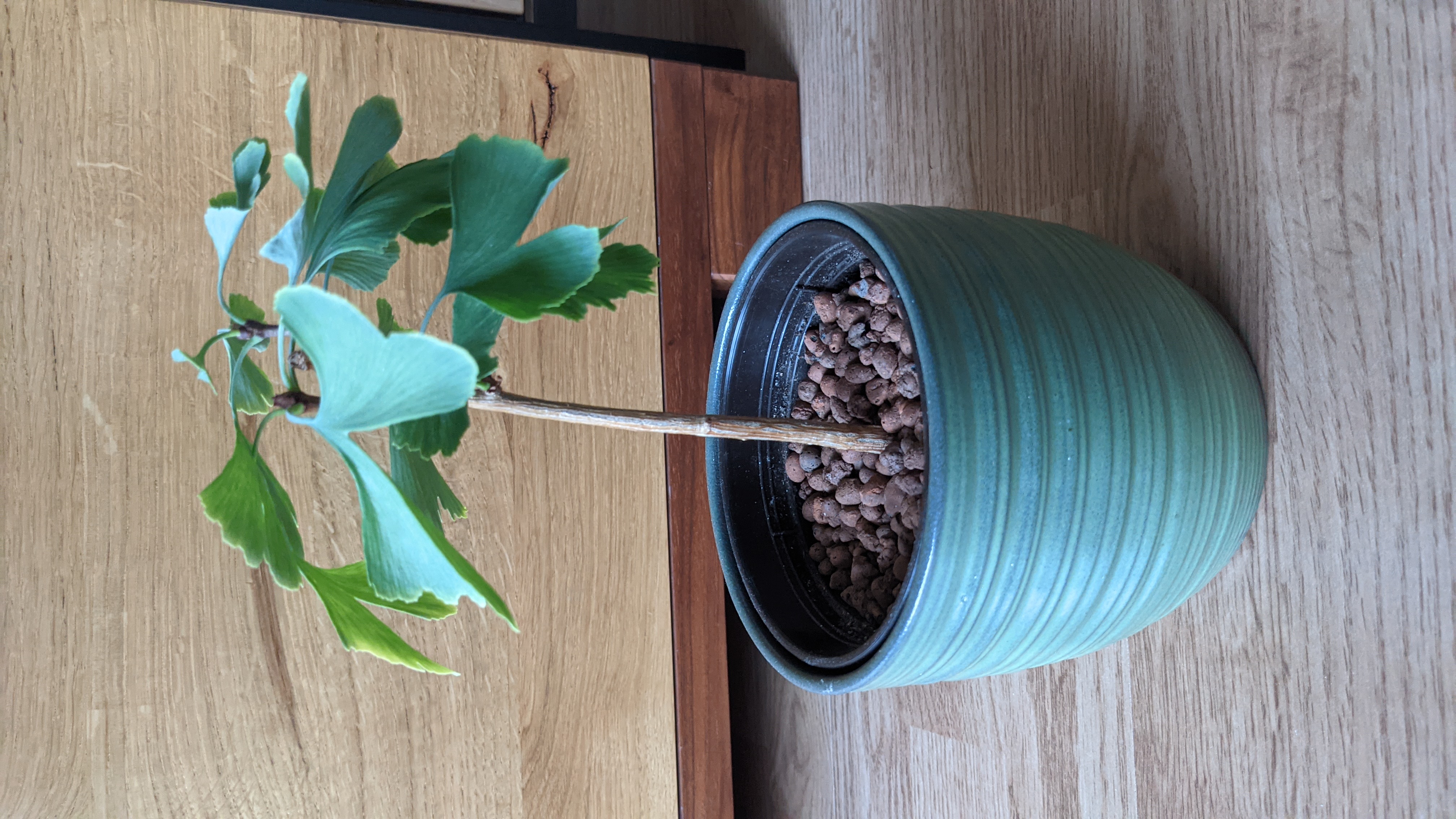
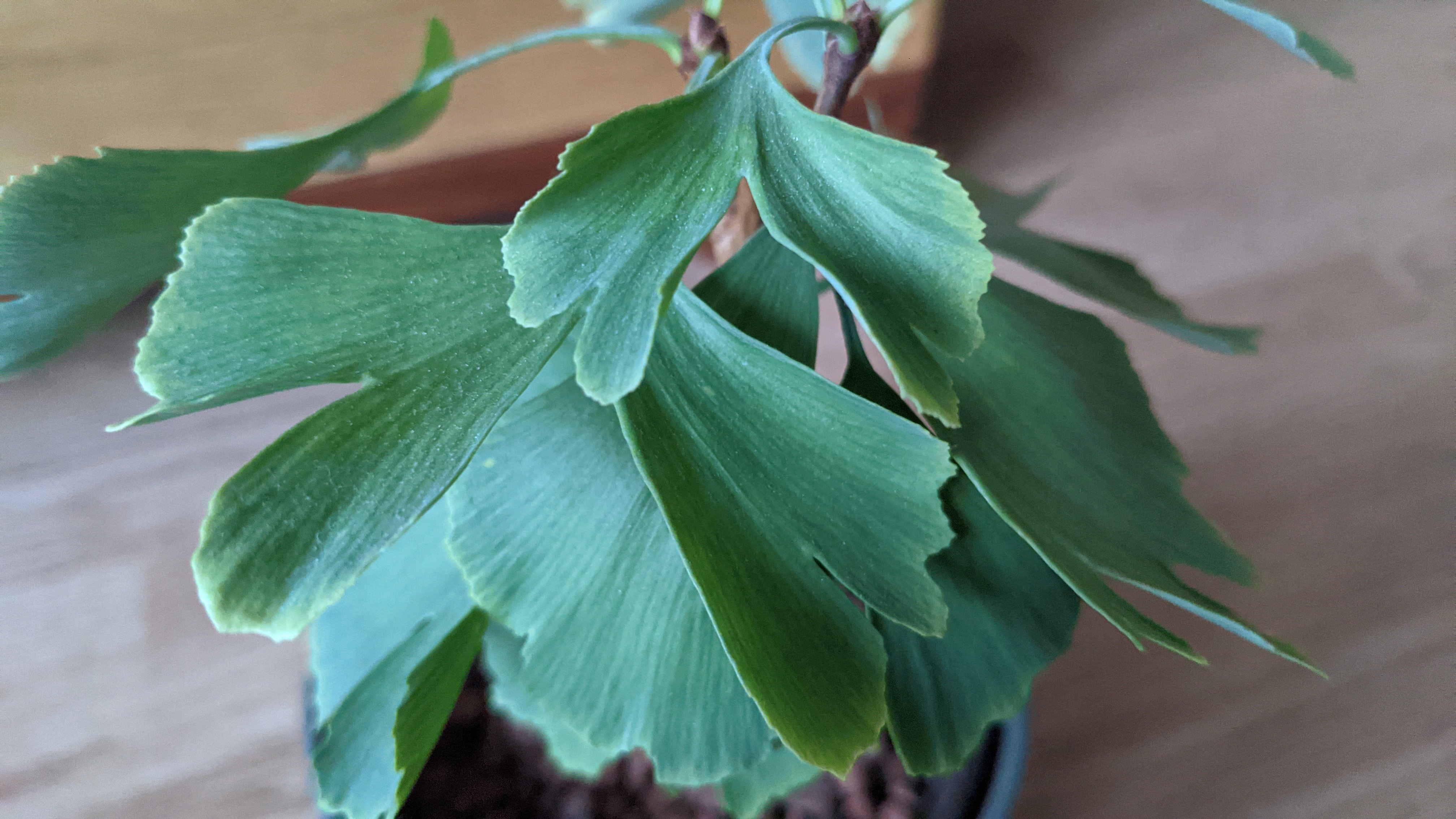
Our ginko tree kept us very busy. We bought the little seedling with 3 leaves in Tharandt Torest Botanical Garden for our fourth anniversary, after our first one (bought for our first or second anniversary) did not survive the winter that well. The sapling taught me about plant care that patience is the most important thing and that plants are more robust than you think.
Our anniversary is in October, so wintering was imminent here too. As expected, it lost its three leaves and ended up being just a stick in the pot. In the spring there were no signs of shoot growth or anything like that, nor in the summer, so we discussed whether we should give it up. Shoots quickly grew and two small leaves grew out, but they were lost again in late winter. We moved in spring and all our plants have bloomed there, but the ginkgo was a long time coming again. In the end a few small leaves appeared again very late, but it didn't look that really healthy. This year we moved again and I looked after our plants (sometimes a little too much) and with a regeneration treatment and some fertilizer, the ginkgo has come to life! Its trunk is thicker, its leaves are diverse and it looks healthy all around and enjoys its place on the windowsill.
Plant-Friday is a category to showcase my plants, get to know more about them and it repeats weekly, to document the development of my indoor and balcony plants. .
Description
The ginkgo originally comes from China and is one of the oldest tree species with a history of more than 300 million years. The plant, also known as a medicinal plant, is used in the areas of dementia, hardening of the arteries, tinnitus and other complaints. In Japan and China it is regarded as a temple tree due to its size and longevity and grows in many places of pilgrimage in the countries.
The unique tree can be classified as both a deciduous and a conifer. Like other deciduous trees, it sheds its foliage in autumn, but its seed texture is similar to that of the conifers. The distinctive leaf shape is also characteristic of the plant: broadly diversified, marked with regular grooves, it is a symbol of strength, life and fertility.
Fun-Fact:
"How the ginkgo got its name is still unclear today. It is believed that the discoverer Engelbert Kaempfer actually christened it Ginkyo. Which means something like silver apricot. The letter “y” could have been exchanged for a “g” due to a typographical or printing error. In 1771 this supposedly wrong spelling was continued by Carl von Linné."
Source: Botanicly.com
Location
The ginkgo likes a bright and sunny location, whereby young plants are still a bit shy of the direct rays of the sun. The windowsill, the garden or a sunny balcony are ideal places. That applies at least to the summer months. After the autumn leaves have been shed, wintering is due: The ideal conditions for the months of November to February are unheated rooms around a temperature of 5°C. A basement would be a suitable location as the lost leaves no longer need any light. During this time, water should also be used sparingly. At the end of February the plant can move back into its summer residence with light watering.
Care
The ginkgo doesn't need a lot of water. A slightly moist soil is ideal. Waterlogging should be avoided to prevent rotten roots. Nutrients should be given with liquid fertilizer every 2-3 weeks from March to September. March / April is the best time to repot, before the first leaves sprout. Young plants can be repotted annually, older plants can be repotted every 3-5 years. This should be laid out with puffed clay at the bottom, followed by an air and water-permeable fleece to avoid silting up, and normal potting soil. If you want the gingko to grow bushier and more compact, you should also use this period to cut shoots about 1cm above the outgrowth. Guide branches should only be shortened if there is insufficient space. Wintering is also important, as already clarified in the previous category: store in a cool (around 5°C) and dry place, little watering, no fertilization, hardly any light necessary. Regular monitoring of the pest infestation is crucial for its health.
Status 27. Aug 2021:
- Height: 17cm
- Diameter: 12cm
- Repottings: 1
- Soil: normal soil
- Location: Windowsill to the west
- Fertilization: 1x every few weeks with Compo öko balance, soon worm tea from the worm bin
- Previous care: So far, our ginkgo has not been overwintered at low temperatures. A rejuvenation cure at the beginning of the year gave it new life and the optimal location at the window leads to a pleasant splendor of leaves.
- Resumé: The first winter storage is pending. Let's see if he'll like it in the basement. Next year it will be repotted and maybe I'll dare to cut something.